

Via Global





.png?width=40&name=Website%20GRAPHICS%20(1).png)


.svg)



Approval Isn't the Finish Line
For most of a study abroad office's work, campus approval is the moment the process concludes. The student applied, the committee reviewed, and the answer came back yes.
For 24,732 applications in the Via 2026 Market Report, roughly 13.4% of the total, approval was a midpoint. Those students then began a second application/process with a provider, in a system nobody on the campus side can see.
The data says something happens in that gap. It also says the campus record has no way to describe it.
What's in this post
- What is a study abroad provider program?
- Why does the process split after approval?
- What happens to provider applications at each stage?
- Is the difference because provider programs are harder to get into?
- How long do provider students wait after approval?
- What the data cannot tell you
- The attention gap
- What should an education abroad office do about it?
- Why this matters beyond one report
- Frequently asked questions
What is a study abroad provider program?
A provider program is a study abroad program operated by a third-party organization rather than by the student's home institution. The student applies through their campus, gets approved to participate, and then enrolls with the provider directly.
Provider programs are an important part of most portfolios. They extend a campus's reach into destinations, disciplines, and program formats no single institution could staff on its own.
They also create a structural reporting problem that almost nobody has named.
Why does the process split after approval?
Every application in this dataset begins the same way: the student applies in Via Global, and the application goes first to the home institution. After that, the path forks.
Institution-run program:
Student applies → Campus reviews → Commitment recorded
Provider program:
Student applies → Campus approves → Second application with the provider → Not visible to the campus
One study abroad program. Two applications. Two systems.
For an institution-run program, campus approval and the student's progression are recorded in the same place. For a provider program, campus approval hands the student to a process the campus record cannot follow. The finish line the institution can see is not the finish line the student is running toward.
What happens to provider applications at each stage?
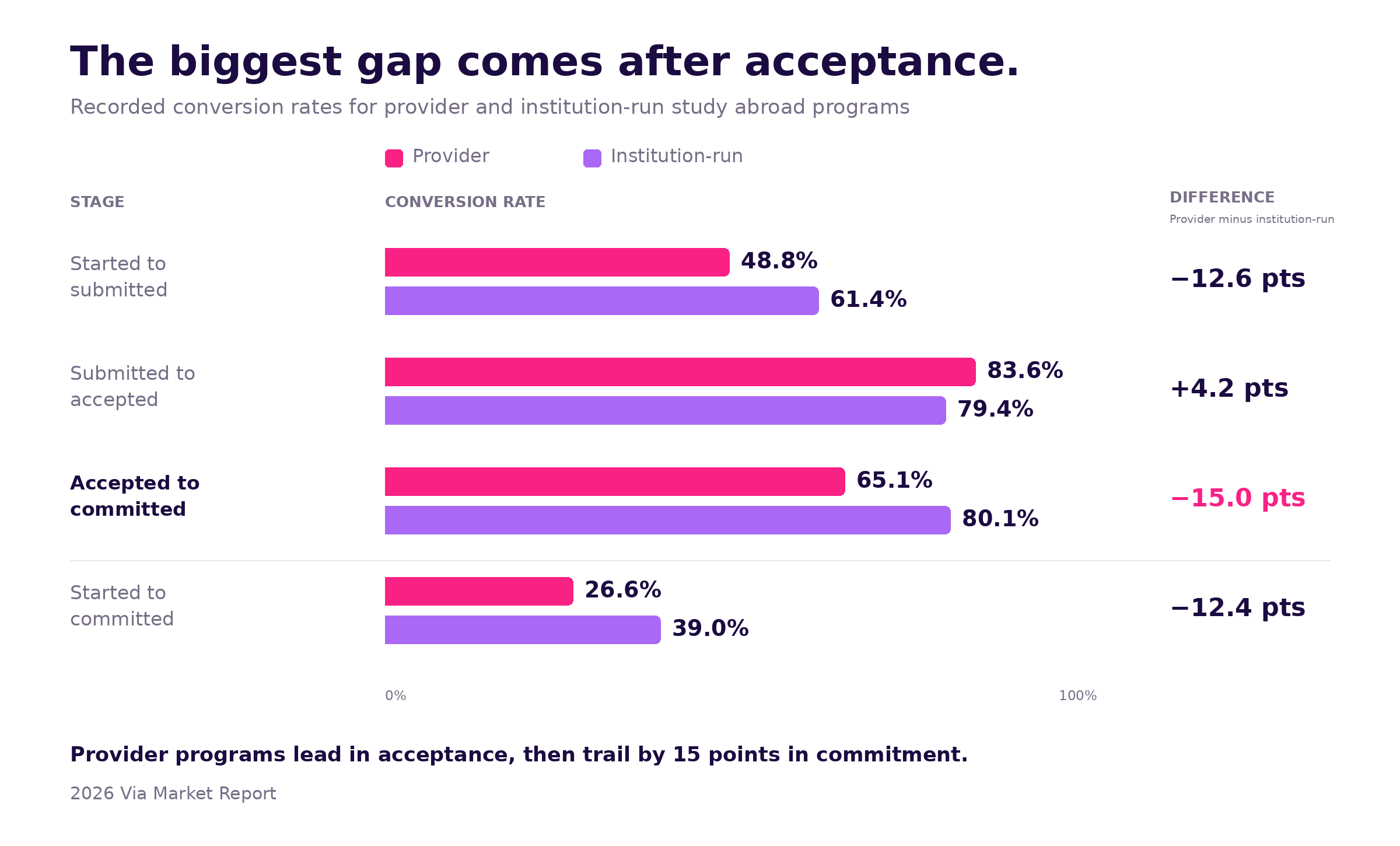
This is where it gets specific. Comparing provider applications with institution-run ones across four transitions:
| Stage | Provider | Institution-run | Difference |
|---|---|---|---|
| Started to submitted | 48.8% | 61.4% | −12.6 pts |
| Submitted to accepted | 83.6% | 79.4% | +4.2 pts |
| Accepted to committed | 65.1% | 80.1% | −15.0 pts |
| Started to committed | 26.6% | 39.0% | −12.4 pts |
End to end, a provider application reaches a recorded commitment at about two-thirds the rate of an institution-run one.
The biggest single gap appears immediately after approval, which is exactly where the process changes hands in most cases.
Is the difference because provider programs are harder to get into?
No, and the acceptance row is what rules that out.
Provider applications are accepted at 83.6% against 79.4% for institution-run programs. If provider programs were simply more selective or more demanding to enter, their acceptance rate would be lower than everyone else's. It is higher.
Provider applications clear campus review more often, and then trail by fifteen points between acceptance and commitment.
This asymmetry highlights the key finding: while standard assumptions suggest momentum drops prior to approval, the evidence reveals that the drop-off actually occurs afterward.
How long do provider students wait after approval?
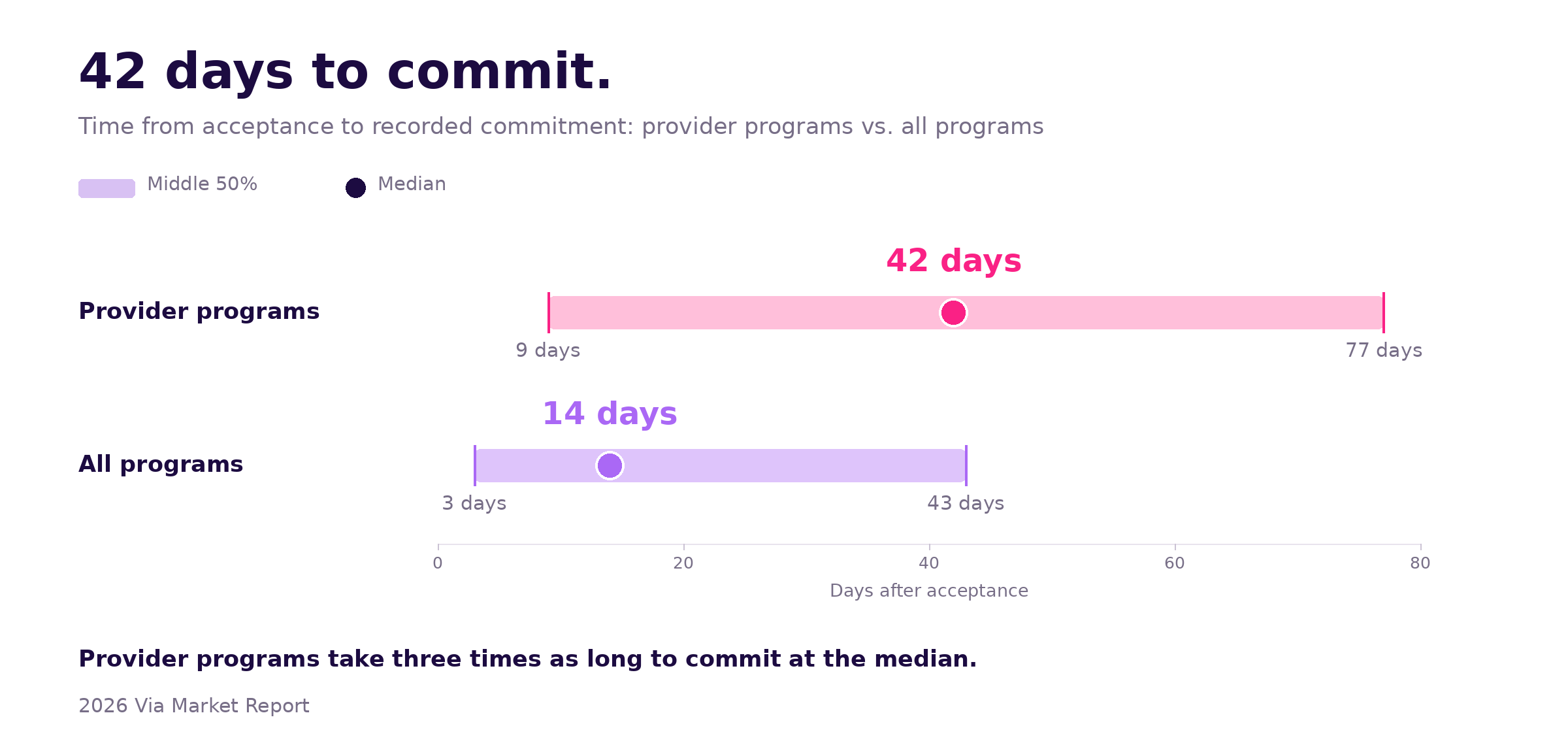
While typical study abroad programs require a median wait time of 14 days, provider programs demand 42 days—a threefold increase.
| Median | Middle 50% | |
|---|---|---|
| Provider programs | 42 days | 9 to 77 days |
| All programs | 14 days | 3 to 43 days |
Between institutional clearance and a confirmed commitment, students applying to third-party options face a median lag of six weeks. Progression drops sharply right at this transition point, just as the timeline expands. Both indicators illuminate the exact same critical juncture.
What the data cannot tell you
The platform cannot see inside the second process. The platform's visibility ends where the secondary process begins. As a result, four plausible factors remain at play, and the data alone cannot single out a primary cause:
- Slower record updating. Campuses may simply update provider records later, so some of the gap is bookkeeping rather than student behavior.
- Cost. Provider programs may differ systematically in price.
- Term timing. Application and start dates may fall differently across the calendar.
- Student mix. The students who choose provider programs may differ in ways the platform does not observe.
This is not a finding that provider students go abroad less. It is a finding that a long stretch of their journey happens where the home institution cannot see it, and that both available signals get worse in that stretch.
The attention gap, which points the same direction
Beyond timing metrics, another notable asymmetry comes to light.
Provider-linked programs generated 28.6% of all browsing activity on the platform and accounted for 13.4% of application records. Provider programs occupy roughly twice the space during discovery that they hold once students begin applying.
That is not a provider conversion rate, and the report is careful about the distinction: attention may begin in one place while the eventual outcome gets recorded somewhere else. Which is precisely the visibility problem, showing up a second time from a different angle.
What should an education abroad office do about it?
The recommendation here is not "use fewer provider programs." The portfolio question and the measurement question are separate, and this is the measurement one.
1. Treat approval as a status change, not an outcome
The single highest-value change is conceptual. If your reporting counts campus approval as the end of the student's journey, your data will look fine while students stall in a stretch you are not measuring. Keep approved provider students in an open, watched state until a final outcome is confirmed.
2. Put a named follow-up point in the gap
The median wait is six weeks and the upper quartile reaches eleven weeks. An office with no scheduled touchpoint in that window will not learn a student stalled until the term starts without them. One check at roughly three weeks costs almost nothing and sits squarely inside the interval where the loss happens.
3. Ask whether students know there is a second application
This is the question we would most like a campus to answer, because the report cannot. Every hypothesis for the fifteen-point gap runs through the student's understanding that approval was not the end. That is testable with a handful of conversations, and no dataset substitutes for it.
4. Separate program mix from performance in your own reporting
Program mix alone moves recorded conversion by roughly 12 points: mostly-provider institutions sit about twelve points below mostly-institution-run ones. If your portfolio shifted toward providers and your conversion rate fell, you may be reading a composition change as a performance change. The method for separating the two is in why your study abroad conversion rate is probably wrong.
5. Record where the handoff happens
You cannot instrument a gap your system does not represent. If provider applications and institution-run applications share a single status ladder, the handoff is invisible by design. Recording the handoff as its own event is what makes the six weeks measurable at all, and it is the change we are building toward on our side.
Why this matters beyond one report
The campus record often ends where the provider process begins. That is not anyone's mistake. It is what happens when two organizations each keep complete records of their own half of a process and no complete record of the whole.
The result is that nobody in this field can currently answer whether provider students ultimately travel less. A lower recorded commitment rate could reflect real student loss, missing visibility, or both, and the data cannot separate them.
That is a solvable problem, and solving it looks less like better software than like two organizations agreeing to exchange an outcome.